


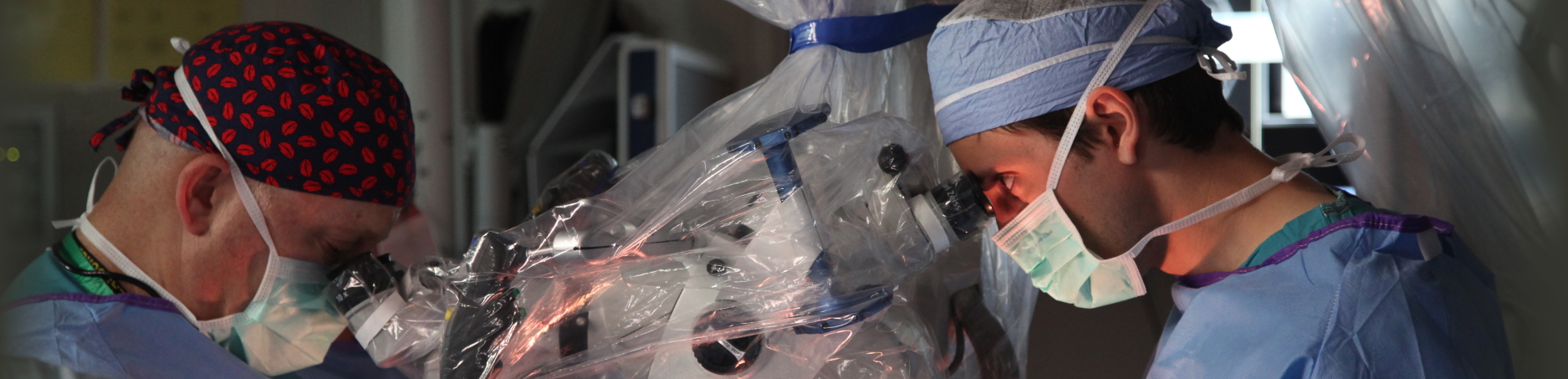
The UW Neurological Surgery Residency Program is a seven-year program accredited by the ACGME.
The program consists of the following experience:
R-1: Internship Year
-
20 weeks of Neurosurgery (at Harborview Medical Center and UW Medical Center)
-
12 weeks of Neurosurgical Intensive Care (NICU), including Neuro Anesthesia
-
8 weeks of Neurology (inpatient and outpatient)
-
4 weeks of Neuropathology
-
4 weeks of Gamma Knife
During this R-1 year, the resident is under the supervision, educational guidance, and mentorship of 40+ neurosurgical faculty, led by Program Director Dr. Ali Ravanpay and Department Chair Dr. Richard Ellenbogen.
R-2: Junior Resident
-
4 months of Trauma/Cranial service at Harborview Medical Center
-
4 month of Cerebrovascular service at Harborview Medical Center
-
4 months of service at University of Washington Medical Center-Montlake
At HMC, the Program is divided into three services: 1) Trauma/Spine service, 2) Trauma/Cranial service, and 3) Vascular service (aneurysms, brain tumors, epilepsy, radiosurgery and deep brain stimulation). The resident will assist in running each of the clinical services with the aid and mentoring of the Chief Resident and faculty assigned to each service.
At UWMC, the resident cares for patients with primary and metastatic brain tumors, pituitary tumors, skull base abnormalities, medically intractable epilepsy with brain mapping, complex spinal pathologies including spinal cord tumors, peripheral nerve lesions, and complex pain and spasticity problems. The rotation at UWMC is unique in that residents receive mentoring by each faculty member at UWMC on an individual basis for each surgical procedure and outpatient encounter.
During this period, the R-2 gains tremendous experience in the operative and non-operative management of head and spinal cord trauma, as well as intracranial hemorrhage of all etiologies. The resident learns the management and evaluation skills required to correctly assess and triage patients arriving in a busy emergency department. The R-2’s interpersonal skills are honed under stressful situations, and their knowledge base grows exponentially through daily interaction with the Chief Resident and faculty.
R-3: Advanced Junior Resident (University of Washington Medical Center – Northwest / Harborview Medical Center / Seattle Children's Hospital)
-
4 months of Spine Neurosurgery (minimally invasive techniques) at University of Washington Medical Center - Northwest
-
4 months of Endovascular/Neuroradiology service at Harborview Medical Center
-
4 months of Junior Pediatric Neurological Surgery at Seattle Children's Hospital
During these two HMC rotations as more advanced Junior residents, R-3s spend most of their time in the operating room, learning elective and trauma spine cases, crash craniotomies, and other intermediate neurosurgical procedures. The R-3 at HMC supervises the intern and R-2 on the service as well. In addition to managing the busy clinical service and supervising four nurse practitioners, the R-3 operates four-to-five days per week.
The resident is responsible for the administration of the service and reports to the full-time faculty members at Seattle Children's Hospital. Residents encounter the full spectrum of pediatric neurosurgery on this rotation, including brain and spinal cord tumors, surgical epilepsy, spinal dysraphism, vascular malformations, spasticity, craniofacial abnormalities, neonatal hemorrhage, hydrocephalus, trauma, spine deformities, and other congenital malformations.
R-4: Senior Resident (Harborview Medical Center / University of Washington Medical Center – Montlake / Seattle Children's Hospital)
- 4 months of Senior Cranial at Harborview Medical Center
- 4 months of Senior Skull Base at University of Washington Medical Center-Montlake
- 4 months of Senior Pediatric Neurological Surgery at Seattle Children's Hospital
Residents foster their clinical interests during this time and prepare for intensive research projects to take place during the R-5 year. During the R-4 year, residents gain valuable leadership and mentorship skills and spend an increasing amount of time in the operative environment. During this year, residents typically take a combination of junior and chief call.
R-5: Research / Elective
- Research and elective assignments vary based on residents’ interest, funding/grant structure, and clinical service needs (locations vary)
R-6 and R-7: Chief Resident
-
4 months of Cranial/Trauma at Harborview Medical Center
-
4 months of Spine Trauma at Harborview Medical Center
-
4 months of Cerebrovascular service at Harborview Medical Center
-
4 months of General Neurological Surgery service at the University of Washington Medical Center-Montlake
-
4 months of Skull Base service at the University of Washington Medical Center-Montlake
-
4 months of Elective (varies)
During the R-6 and R-7 years, chief residents gain hone skills in areas such as spine instrumentation, brain mapping, skull base anatomy, and trauma surgery/management. As the vascular chief, they commonly engage with vascular (aneurysm and AVM) and tumor patients. The skull base chief gains experience in neuro-interventional radiology, neuro-oncology, minimally invasive spine procedures, pain procedures, and surgical epilepsy.
The Chief Resident is responsible for coordinating the operative schedule, mentoring junior residents, and supervising the clinical activities on the respective Neurological Surgery services.
The R-7 is responsible for all inpatient care, emergency care, consultations, surgical admissions, and operations of the respective services. At the end of each four-month rotation, the R-7 is expected to develop the advanced psychomotor and mature interpersonal skills necessary to manage the broad spectrum of patient diseases cared for at each hospital.
Specifically, the R-7 will be capable of evaluating and managing patients with the entire spectrum of brain tumors, epileptic foci, skull base lesions, aneurysms, vascular malformations, extracranial vascular disease, movement disorders, intracranial hematoma, traumatic brain and spine injury, infections, congenital anomalies, hydrocephalus, surgically correctable pain issues, peripheral nerve problems, and spine fractures/diseases/deformities.